Taper Roller Bearing Spec Table
Uses tapered rollers to carry combined radial and axial loads. Found in automotive hubs, transmissions, and machine tool spindles.
Practical Notes
- Inner (cone) and outer (cup) rings separate — never mix sets. Combining rings from different sets disrupts preload.
- Measure axial play with a dial gauge while rotating shaft by hand during preload adjustment. Excessive preload causes overheating and reduced life.
Selection Guide
Supports combined radial and one-direction axial loads. Used in automotive hubs, reducers, machine tools. Separable inner (cone) and outer (cup) rings allow independent mounting and preload adjustment. Bidirectional axial loads require back-to-back or tandem arrangements.
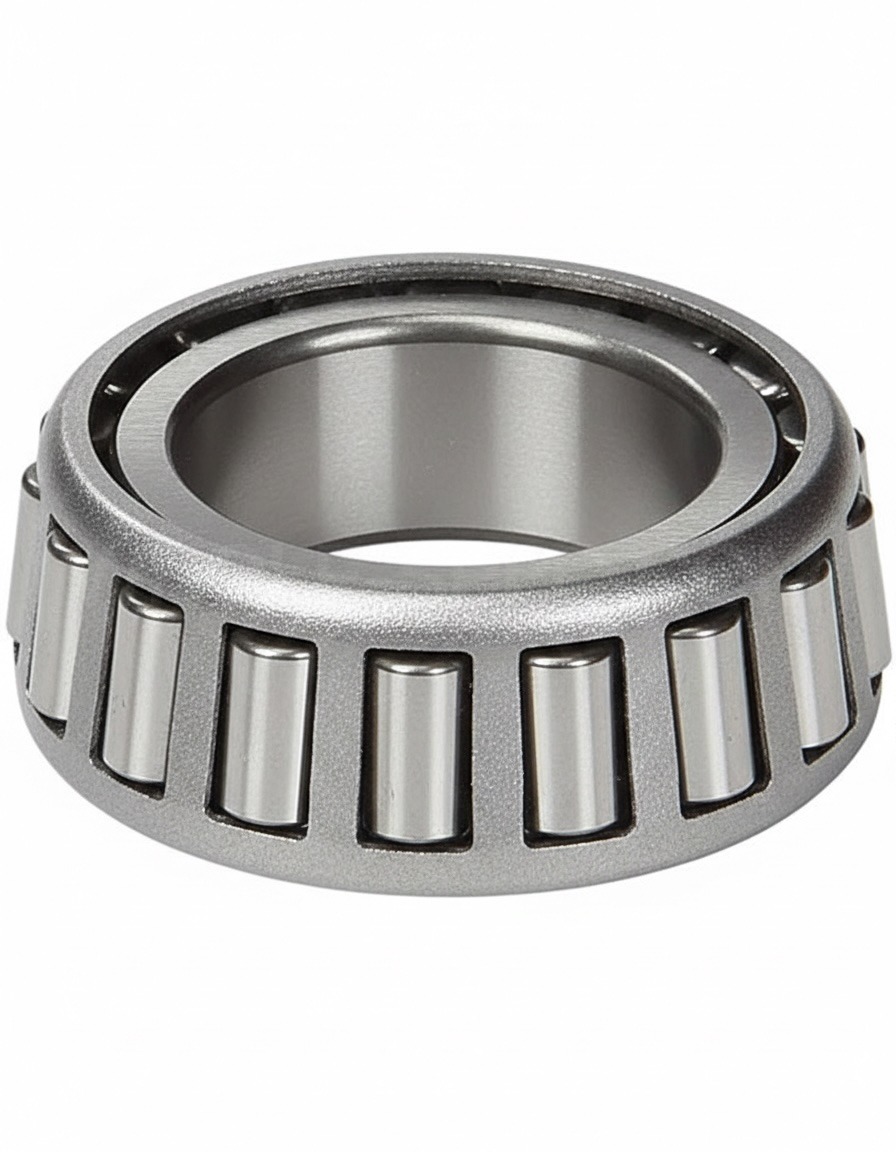 Taper Roller Bearing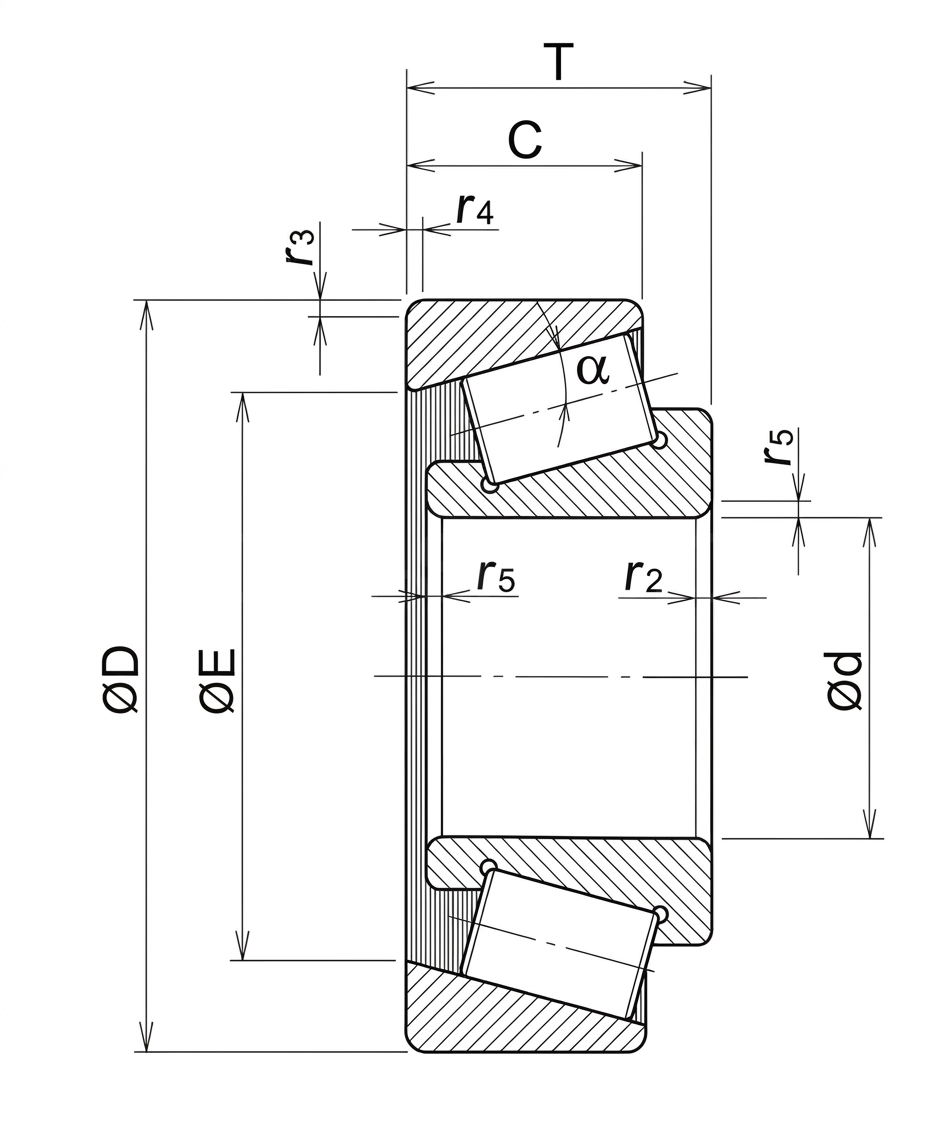
JISISODINABMATaper Roller Bearing
7 sizesThe dimensions below are identical across JIS B 1512 · ISO 355 · JIS B 1534 · DIN 720 · ABMA Std 19.
| Nominal | d | D | E | C | T | α | r1 | r2 | r3 | r4 | r5 |
|---|---|---|---|---|---|---|---|---|---|---|---|
| 30202 | 15 | 35 | 28.5 | 10 | 11.75 | 12.957° | 1 | 1 | 0.6 | 0.6 | 0.6 |
| 30203 | 17 | 40 | 32.5 | 11 | 13.25 | 12.957° | 1 | 1 | 0.6 | 0.6 | 0.6 |
| 30204 | 20 | 47 | 39 | 12 | 15.25 | 12.957° | 1.5 | 1.5 | 0.6 | 0.6 | 0.6 |
| 30205 | 25 | 52 | 44 | 13 | 16.25 | 14.036° | 1.5 | 1.5 | 0.6 | 0.6 | 0.6 |
| 30206 | 30 | 62 | 53 | 14 | 17.25 | 14.036° | 1.5 | 1.5 | 0.6 | 0.6 | 0.6 |
| 30207 | 35 | 72 | 62 | 15 | 18.25 | 14.036° | 2 | 1.5 | 0.8 | 0.8 | 0.8 |
| 30208 | 40 | 80 | 69 | 16 | 19.75 | 14.036° | 2 | 1.5 | 0.8 | 0.8 | 0.8 |
Key Features
- Tapered rollers make line contact to support heavy combined radial and thrust loads
- Separable inner (cone) and outer (cup) rings for independent mounting and preload adjustment
- Series 30200–33200; axial load ratio varies with contact angle (10°–30°)
Key Applications
Automotive hubs, reducer output shafts, crane slewing, machine tool spindles, rolling mill roll necks
In-Depth Guide
Preload vs end-play — when to set up negative, zero or positive clearance
In a tapered roller bearing the internal clearance is set by the axial position during assembly, so the same bearing behaves completely differently depending on the setup. Positive clearance (end-play) has low friction and heat and suits ordinary shafts running at high speed. Preload (negative clearance), by contrast, raises stiffness and cuts runout and noise, so it is used on machine-tool spindles and reducer pinions — at the cost of more heat and shorter life. Joints that see shock and tilt, like an automotive wheel hub, are set to zero or slight positive end-play. In short, preload is not always good; it trades life for stiffness.
Opposed arrangements — back-to-back (O / DB) and face-to-face (X / DF), and thermal growth
When two tapered bearings face each other, the arrangement governs stiffness and thermal behavior. Back-to-back (O arrangement, DB) has a wide spacing between the effective load centers, giving high moment and tilt stiffness, so it is used on bending-loaded shafts like wheel hubs and pinions. Face-to-face (X arrangement, DF) has the load centers close together, allowing more misalignment and easier adjustment. The decisive difference is thermal growth — as the shaft heats and lengthens, DB increases preload (risking over-preload and seizure) while DF reduces it. So where the shaft runs hot, DF is the safer choice.
Contact angle and the 30200 vs 30300 series — calculating induced thrust
A tapered bearing carries more axial load the larger its contact angle. The 30300 and 32000 series have a large contact angle for axial-dominant loads, while the 30200 series has a small angle for mostly radial loads. The catalog lists an e value and a Y factor: when the axial-to-radial ratio Fa/Fr exceeds e, the axial load must be brought into the equivalent-load calculation separately. A tapered bearing also generates an axial force in one direction just from carrying a radial load (induced thrust); in an opposed pair, the Fa ≈ 0.5·Fr/Y produced by one ring is reacted by the other. So tapered bearings are always analyzed as a pair, computing the induced thrust on both sides together.
Cup/cone compatibility and metric (30205) vs inch (LM/JLM, Timken) part numbers
A tapered bearing has a separable cup (outer ring) and cone (inner ring), but not every cup and cone can be paired. The metric 30205 (ISO/JIS) families and the inch LM/JLM (Timken) families differ entirely in both dimensions and numbering, so mating a cup from one series (e.g. LM12710) with a cone from another does not give the right contact. A genuine assembly has its cup and cone matched as a set, so when ordering a replacement, check the individual cup and cone numbers and pair them using the maker interchange table. Mixing different sets during handling or storage upsets the preload, so manage them as sets.
Mounting — interference fit on the rotating ring, heating the cone, and taper pumping lubrication
The rotating ring (usually the cone) goes in with an interference fit (k5, m6, etc.) and the stationary ring slightly loose — a loose rotating ring slips on its seat and creeps and wears. Do not hammer the cone in; heat it to 80–120 °C or press it squarely and evenly. Do not set preload by lock-nut torque — torque and preload are non-linear, so turn the shaft by hand and measure the axial clearance with a dial gauge to hit the target. Tapered rollers also act as a pump, driving lubricant toward the large-diameter end as they rotate, so design the oil passages and level so the oil circulates and replenishes along that flow.
FAQ
How is taper bearing preload adjusted?
Adjust with shims or lock nut tightening. Measure axial clearance with a micrometer or dial gauge to set target preload. Excessive preload causes overheating and reduced life.