Rivet Nut Spec Table
A blind rivet-type nut installed into sheet metal to create a threaded hole, used where only one side is accessible.
Practical Notes
- Verify grip range matches sheet thickness. Out-of-range installation results in incomplete crimping — the nut spins or pulls out.
- Always perform push-out test after installation. Insufficient crimping causes in-service failure.
Selection Guide
Creates threaded points in thin sheet (0.5–3mm) with single-side access. Crimp-installed for permanent threads. Common in automotive bodies, electronics chassis, and aircraft panels. Stronger under repeated disassembly than tapping screws; no heat distortion unlike weld nuts.
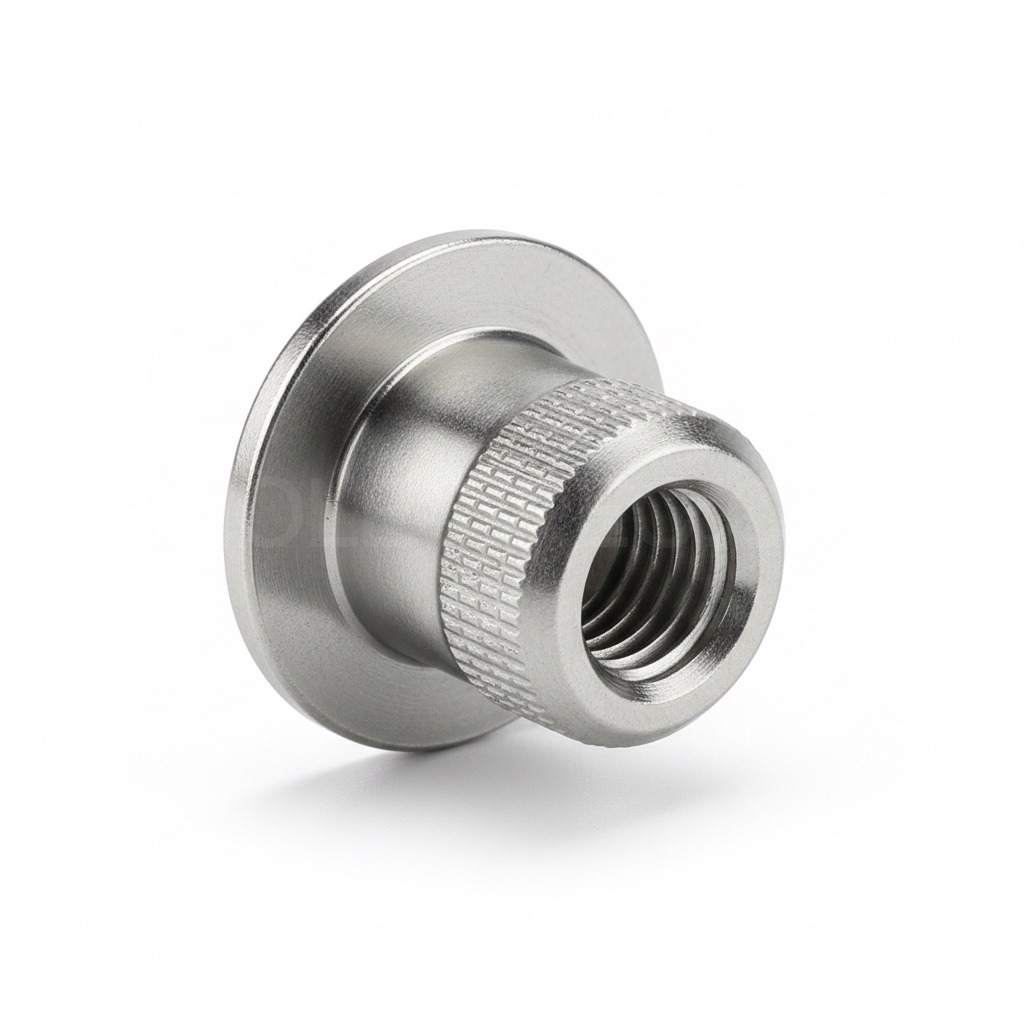 Rivet Nut
Rivet Nut
6 sizes| Nominal | d | P | H (Height) | B (Wrench) | Other |
|---|---|---|---|---|---|
| M3 | 3 | 0.5 | - | - | - |
| M4 | 4 | 0.7 | - | - | - |
| M5 | 5 | 0.8 | - | - | - |
| M6 | 6 | 1 | - | - | - |
| M8 | 8 | 1.25 | - | - | - |
| M10 | 10 | 1.5 | - | - | - |
Key Features
- Crimped into thin sheet metal to create a female (internal) thread
- Supports sheet thickness 0.5–3.0 mm; creates fastening point with single-side access
- Flat head type sits flush with surface after installation; no countersink needed
Key Applications
Automotive body sheet metal, electronics chassis, aircraft panels, elevator interiors, appliance sheet metal
STEP File Downloads
Free 3D CAD models (STEP AP214). Built to real standard dimensions; threads are simplified (plain shank) per free-library convention.
FAQ
What is rivet nut grip range?
The installable sheet thickness range. E.g., 0.5–3.0mm grip means only that thickness range. Out-of-range installation causes poor crimping and insufficient retention.