Unit Converter
Conversion Type
What It Does
Converts between SI units and conventional or inch units that get mixed up on drawings and catalogs. It spans length, area, volume; force, pressure, torque, energy, power; speed, angular velocity; plus temperature, mass and flow. Pick a conversion type, type a value, and the result appears at once.
Conversion Types
Fourteen types are offered. Geometry covers length (mm to inch), area (mm² to inch²), volume (cm³ to inch³). Mechanics covers force (N to kgf), pressure (MPa to kgf/cm²), pressure (MPa to psi), torque (N·m to kgf·cm), energy (J to kgf·m), power (W to PS/HP). Motion covers speed (m/s to ft/min) and angular velocity (rpm to rad/s). Other covers temperature (°C to °F), mass (kg to lb), flow (L/min to m³/h). The left field is input, the right is the result, shown to four decimals.
Key Formulas
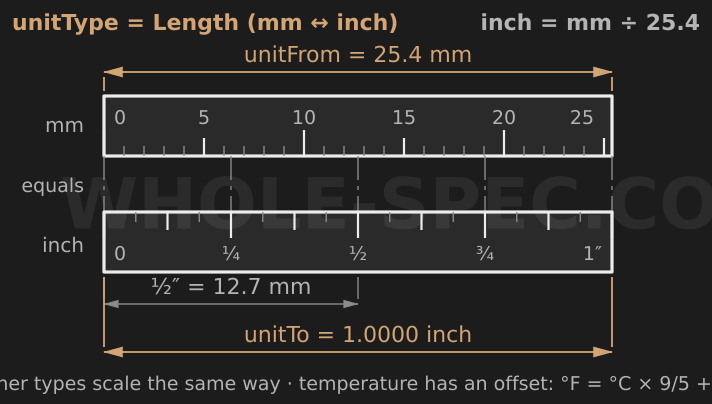
Each input is multiplied or divided by a fixed factor. Length inch=mm/25.4, area inch²=mm²/645.16, volume inch³=cm³/16.3871, force kgf=N/9.80665, pressure kgf/cm²=MPa*10.19716, psi=MPa*145.038, torque kgf·cm=N·m*10.19716, energy kgf·m=J/9.80665, power PS=W/735.499, speed ft/min=m/s*196.85, angular velocity rad/s=rpm*pi/30, mass lb=kg*2.20462, flow m³/h=(L/min)/16.6667. Only temperature is not proportional; it carries an offset: °F=°C*9/5+32.
Worked Example
In pressure mode, entering 10 MPa gives 10*10.19716=101.9716, about 101.97 kgf/cm². In torque mode, 50 N·m gives 50*10.19716=509.858, about 509.86 kgf·cm. In temperature mode, 100 °C gives 100*9/5+32=212 °F, the correct boiling point. In angular velocity mode, 1500 rpm gives 1500*pi/30=157.0796 rad/s. The default length 25.4 mm gives 25.4/25.4=1.0000 inch, confirming one inch.
Notes
The power unit PS is metric horsepower (1 PS=735.499 W) and differs from US horsepower (1 HP=745.7 W), so check the catalog source. The kgf/cm² family is technical atmosphere; do not confuse it with the standard atmosphere (atm). Always check the unit labels on the input and result fields. Results are rounded at the fourth decimal, so apply extra digits yourself when high precision is needed. The area and volume factors (645.16, 16.3871) equal the square and cube of the length factor 25.4.
Unit Conversion Calculator — US Engineering Practice
Unit conversion errors are a disproportionate source of costly engineering mistakes in US practice precisely because the United States uses both customary (inch-pound) and SI (metric) systems simultaneously across different industries, companies, and even different departments within the same company. The most famous example — the 1999 Mars Climate Orbiter loss ($327.6M) — resulted from a navigation team delivering data in pound-force seconds while the spacecraft expected newton-seconds. While most unit errors are less dramatic, they are pervasive: lb-mass vs lb-force confusion corrupts force calculations; mixing lb-ft and lb-in torques by a factor of 12 causes structural failures; gauge vs absolute pressure errors shift system behavior by one atmosphere. ANSI Y14.5-2018 default tolerances assume inch units unless millimeters are explicitly noted — an untitled drawing dimension is assumed to be in inches, which is a conversion hazard when importing metric CAD models.
Formula and Methodology
Key US-specific conversions: Force: 1 lbf = 4.44822 N. Mass: 1 lb-mass (lbm) = 0.453592 kg; 1 slug = 14.5939 kg = 32.174 lbm. Acceleration: 1 ft/s² = 0.3048 m/s²; standard gravity g = 32.174 ft/s² = 9.80665 m/s². Torque: 1 lb-ft = 12 lb-in = 1.35582 N·m. Pressure: 1 psi = 6,894.76 Pa = 0.068948 bar; 1 atm = 14.696 psi = 101,325 Pa; gauge pressure P_gauge = P_absolute − 14.696 psi (at sea level). Energy: 1 BTU = 778.16 lb-ft = 1,055.06 J; 1 HP = 550 lb-ft/s = 745.7 W = 2,544.4 BTU/hr. Stress/Modulus: 1 ksi = 6,894,757 Pa ≈ 6.895 MPa; 1 Mpsi = 6.895 GPa. Length: 1 in = 25.4 mm exactly; 1 ft = 0.3048 m. Density: 1 lb/in³ = 27,679.9 kg/m³.
US Standards and References
- ANSI Y14.5-2018 — Dimensioning and Tolerancing — States that drawing dimensions are in inches by default (Section 1.5); metric drawings must include explicit "UNLESS OTHERWISE SPECIFIED: DIMENSIONS ARE IN MILLIMETERS" in the title block. Failure to observe this distinction causes systematic conversion errors when importing drawings across unit systems.
- NIST Special Publication 811 — Guide for the Use of the International System of Units — Authoritative US federal reference for SI unit usage, conversion factors, and proper expression of quantities with uncertainty; used as the technical authority for US government and standards body publications.
- IEEE/ASTM SI-10 — American National Standard for Metric Practice — Governs the use of SI units in US engineering documents; specifies acceptable dual-unit notation (primary SI with inch values in parentheses, or vice versa) for drawings and specifications targeting both domestic and international audiences.
Common Engineering Pitfalls
The lb-mass vs lb-force confusion is the most endemic US-specific pitfall. In the US customary system, pound-force (lbf) is the unit of force, while pound-mass (lbm) is the unit of mass. Newton's second law F = ma requires the gc conversion: F [lbf] = m [lbm] × a [ft/s²] / gc, where gc = 32.174 lbm·ft/(lbf·s²). Engineers who write F = m × a without gc will obtain a result 32.174× too large when a = 32.174 ft/s² (one standard g). In SI, this problem does not exist because 1 N = 1 kg·m/s² exactly. US engineers accustomed to SI who then work in lbm/lbf must consistently apply gc — a discipline that is frequently lost in spreadsheet calculations passed between engineers.
The lb-ft vs lb-in torque confusion causes a factor-of-12 error that is large enough to be immediately obvious in absurd results, yet still occurs regularly because torque wrenches are calibrated in lb-ft while fastener torque specs in machine design are often given in lb-in. A torque of 150 lb-in is 12.5 lb-ft — entering 150 lb-ft into a structural calculation produces a 12× unconservative result. Always check torque unit consistency before comparing torque values from different sources: IFI tables are in lb-ft; Shigley's machine design problems are commonly in lb-in; automotive specs use N·m.
Software and Tools
Wolfram Alpha handles complex unit conversions with symbolic expression parsing and is widely used by US engineers for quick cross-checks. NIST's online unit converter (physics.nist.gov/cuu/Convert) is authoritative for SI definitions. Engineering unit conversion is built into MATLAB, Mathcad Prime, and PTC Mathcad (all widely used in US engineering), which enforce unit dimensionality and flag inconsistencies at runtime. SolidWorks and PTC Creo both support per-document unit settings and warn when mixing unit systems across imported components. For drawing review, ASME Y14.5 training emphasizes the title block unit check as the first step in any drawing review procedure.
Imperial Conversion Examples
Steel modulus: 29,000 ksi × 6.895 = 200,000 MPa = 200 GPa. Torque: 100 N·m × 0.7376 = 73.76 lb-ft = 885.1 lb-in. Pressure: 100 psi × 6.895 = 689.5 kPa; 100 psig = 100 psia + 14.696 psia = 114.696 psia = 791.0 kPa absolute. Density: 0.284 lb/in³ × 27,680 = 7,861 kg/m³ (steel). Power: 10 HP × 745.7 = 7,457 W = 7.457 kW; 10 HP × 33,000 = 330,000 lb-ft/min = 5,500 lb-ft/s.
Common Calculation Questions
Q1: What is the difference between psi, psig, and psia — and when does it matter?
A1: psia = pounds per square inch absolute (referenced to perfect vacuum). psig = gauge pressure = psia minus local atmospheric pressure (approximately 14.696 psi at sea level). Most pressure gauges and specifications in US practice use gauge pressure. It matters critically in gas law calculations (PV = nRT requires absolute pressure), compressor sizing (compression ratio uses absolute inlet and outlet pressure), and altitude corrections. A vessel rated at "150 psig" has a maximum absolute pressure of 164.7 psia at sea level.
Q2: How do I convert between lb-mass and slug in Newton's second law?
A2: 1 slug = 32.174 lbm. When using F = ma with F in lbf and a in ft/s², use mass in slugs (m = weight in lbf / 32.174). When using F = ma/gc with mass in lbm, gc = 32.174 lbm·ft/(lbf·s²). Both approaches give identical results — the choice is which form is less prone to error in your calculation environment. Slug-based calculation eliminates the gc factor and is preferred for dynamics problems in US engineering education (Shigley's, Beer & Johnston).
Q3: My drawing says 1.000 in ± 0.005 — what is that in millimeters?
A3: 1.000 in = 25.400 mm exactly (1 in = 25.4 mm exactly by international agreement since 1959). ±0.005 in = ±0.127 mm. The converted dimension is 25.400 ± 0.127 mm. Note that ASME Y14.5 requires rounding converted tolerances to match the precision of the original — do not report 25.4001 mm from a 1.000-in nominal; round to 25.40 mm to match the implied precision of four significant figures.
Q4: Why does 1 horsepower equal exactly 550 ft·lbf/s?
A4: James Watt defined 1 horsepower as 33,000 ft·lbf/min (550 ft·lbf/s) in the 18th century, based on his estimate of an average horse's sustained work output to market steam engines. This definition was codified and remains the US mechanical horsepower. Electrical horsepower (used in motor ratings) = 746 W exactly. Boiler horsepower = 33,475 BTU/hr. In US practice, "HP" on a motor nameplate means electrical HP (746 W), not mechanical HP (745.7 W) — a 0.04% difference irrelevant in practice but technically distinct.
Q5: What is the ANSI Y14.5 default tolerance for an untitled inch dimension?
A5: ANSI Y14.5-2018 does not itself specify default tolerances — it requires each drawing to include a general tolerance note in the title block. Common US practice per ASME Y14.5M and ASME Y14.100 specifies: ±0.010 in for one decimal place (X.X), ±0.005 in for two decimal places (X.XX), ±0.001 in for three decimal places (X.XXX), and ±0.0005 in for four decimal places (X.XXXX). Angle tolerances default to ±0.5° or ±1°. These are conventions — the title block governs, and each organization's drawing standard supersedes any general rule.