Ad
I-Beam Spec Table
I-Beam Specifications — 14 sizes
KS D 3502JIS G 3192
An I-section beam, narrower than H-beams, used in traditional structural designs.
Practical Notes
- Narrower flanges than H-beams mean weaker weak-axis strength. Better suited as beams than columns.
- Inner flange surface is sloped (about 8–14%) — taper washers may be needed for bolted connections.
Selection Guide
Traditional I-section beam. Narrower flanges than H-beams — lighter but weaker in the weak axis. Used for simple beam applications.
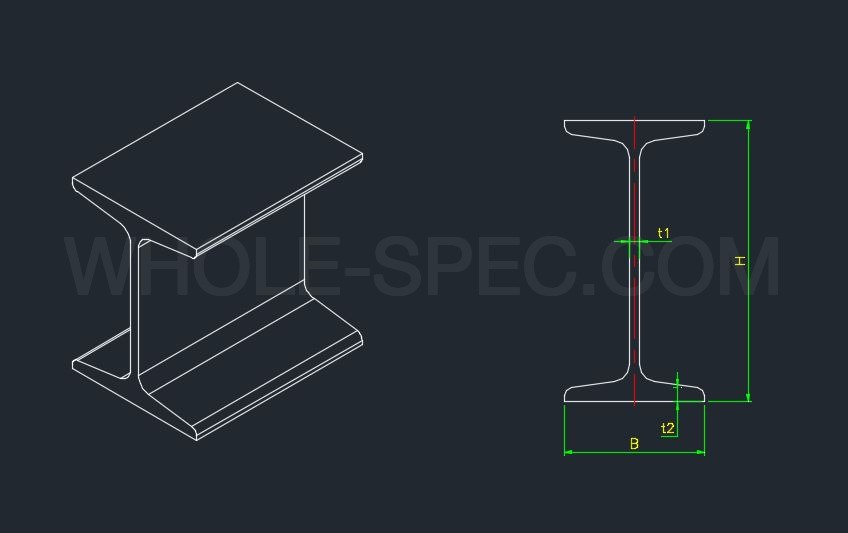 I-Beam
KSJISI-Beam
7 sizesThe dimensions below are identical across KS D 3502 · JIS G 3192.
| Nominal | H | B | t1 | t2 | Weight |
|---|---|---|---|---|---|
| I100 | 100 | 75 | 5 | 8 | 12.5 |
| I150 | 150 | 100 | 6 | 9 | 20.3 |
| I200 | 200 | 125 | 7 | 11 | 33.1 |
| I250 | 250 | 150 | 8 | 12 | 44.2 |
| I300 | 300 | 175 | 9 | 13 | 56.8 |
| I350 | 350 | 175 | 10 | 14 | 66.5 |
| I400 | 400 | 200 | 11 | 16 | 85.5 |
Key Features
- Traditional I-section with tapered inner flange (~8%); predecessor to H-beam standards
- KS D 3502; 100×75–600×190 mm; slender cross-section with height much greater than flange width
- Section modulus concentrated on x-axis; specialized for unidirectional bending resistance
Key Applications
Simple beam structures, crane girders, bridge secondary members, legacy building reinforcement, transport rails
STEP File Downloads
Free 3D CAD models (STEP AP214). Built to real standard dimensions; threads are simplified (plain shank) per free-library convention.
DownloadI-BEAM-I100.step
All sizes · CAD guide →FAQ
Difference between I-beam and H-beam?
I-beams have narrow flanges with sloped inner surfaces (8–14%). H-beams have wide flanges with parallel inner surfaces. H-beams offer better biaxial strength and easier bolted connections.