Weight Calculator
Material
Shape
What It Calculates
Computes the volume and weight of a simple shape (plate, round bar, pipe) from the material density and the entered dimensions. Useful for estimating cut-stock mass, handling loads, and material cost.
Key Formulas
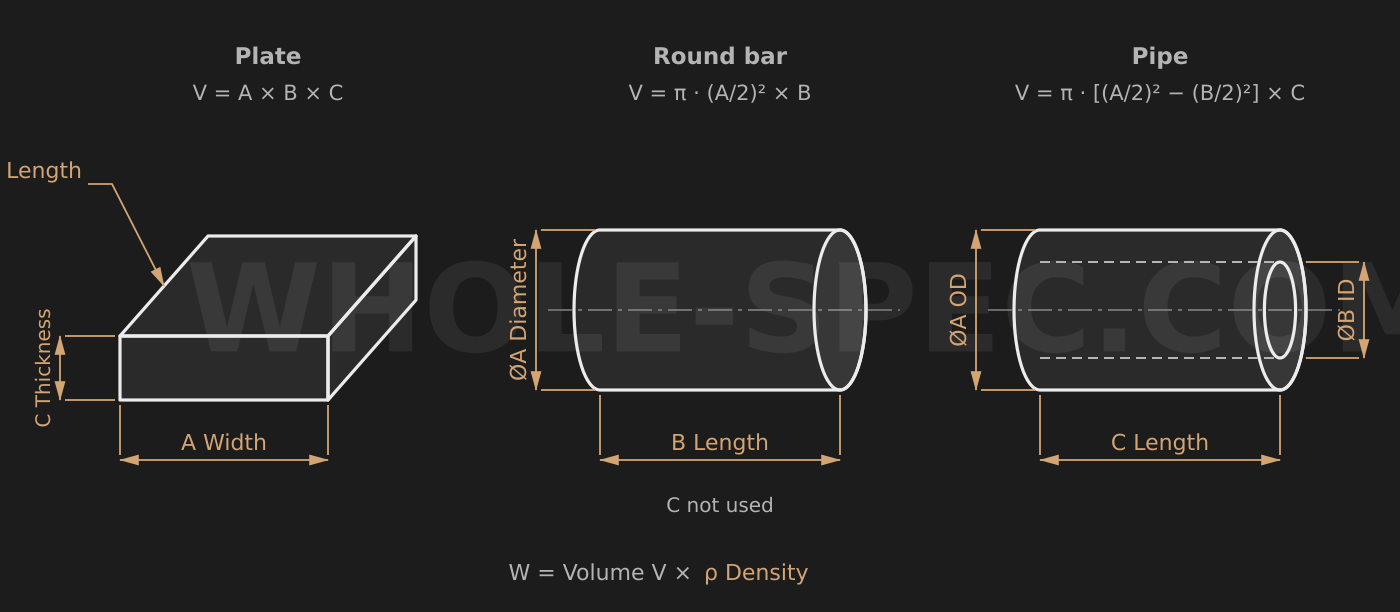
The volume V (mm³) is found per shape first. Plate: V = width × length × thickness. Round bar: V = π × (dia/2)² × length. Pipe: V = π × ((OD/2)² − (ID/2)²) × length.
Weight is W(kg) = V × ρ ÷ 1,000,000, where ρ is density in g/cm³. Since V is in mm³, dividing by 1e6 reconciles the units to kg.
Inputs
Selecting a material sets the density ρ: mild steel 7.85, stainless 7.93, aluminum 2.71, copper 8.93, brass 8.50 (g/cm³). Choosing a shape switches the input fields to width/length/thickness, diameter/length, or OD/ID/length. Enter all dimensions in mm.
Worked Example
Take a mild-steel (ρ=7.85) round bar, diameter 50mm, length 200mm. V = π × (50/2)² × 200 = π × 625 × 200 = 392,699 mm³. W = 392,699 × 7.85 ÷ 1,000,000 = 3.083 kg (about 3,082.7 g).
Units and Notes
Switching the input unit to inches reads dimensions in inches, multiplies internally by 25.4 to mm, and reports volume in inch³. Results are theoretical weights of an ideal cross-section, so chamfers, holes, fillets, and threads are not accounted for. Rolling tolerances and real density scatter can shift measured values by a few percent.
Material Weight Calculator — US Engineering Practice
Material weight calculation is a foundational task in US structural, mechanical, and manufacturing engineering — affecting shipping cost estimates, structural load calculations, lifting device selection, and material cost forecasting. US practice uses volumetric density in lb/in³ for compact machine components and lb/ft³ for structural and architectural applications. The dominant reference for US material densities is the ASTM material specification for each alloy (ASTM A36 for structural steel, ASTM B209 for aluminum sheet, ASTM B152 for copper sheet), which includes density as a physical property. For quick reference, Speedy Metals, Online Metals, and Metal Supermarkets publish weight-per-foot tables for standard bar, tube, and sheet forms that are widely used in US fabrication shops. The relationship between density in lb/in³ and the more common kg/m³ (SI) involves the conversion factor 27,679.9, a number worth memorizing for engineers who regularly interface between US and metric specifications.
Formula and Methodology
Weight W = ρ × V, where ρ = density [lb/in³ or kg/m³] and V = volume [in³ or m³]. For common shapes: Rectangular bar: V = L × W × H [in³]. Cylinder (solid): V = π/4 × D² × L [in³]. Hollow tube: V = π/4 × (D_o² − D_i²) × L [in³]. Sphere: V = π/6 × D³ [in³]. Reference US densities: Carbon/alloy steel: 0.284 lb/in³ (7,860 kg/m³). 304/316 stainless steel: 0.286–0.290 lb/in³ (7,920–8,030 kg/m³). 6061 aluminum: 0.098 lb/in³ (2,710 kg/m³). 7075 aluminum: 0.101 lb/in³ (2,800 kg/m³). Copper (C110): 0.323 lb/in³ (8,940 kg/m³). Brass (C360): 0.307 lb/in³ (8,500 kg/m³). Gray cast iron: 0.260 lb/in³ (7,200 kg/m³). Titanium (Ti-6Al-4V): 0.160 lb/in³ (4,430 kg/m³). ABS plastic: 0.038 lb/in³ (1,050 kg/m³). Weight to mass conversion: m [lbm] = W [lbf] (at standard gravity, weight and mass have numerically equal values in US customary when measured in lbf and lbm respectively). m [slugs] = W [lbf] / 32.174.
US Standards and References
- ASTM A36/A36M — Standard Specification for Carbon Structural Steel — Includes density 0.284 lb/in³ (7,860 kg/m³) as a mandatory physical property; the density value from ASTM specifications takes precedence over handbook estimates for ASTM-certified material in structural calculations.
- ASTM B209 — Standard Specification for Aluminum and Aluminum Alloy Sheet and Plate — Tabulates density by alloy designation (6061: 0.098 lb/in³, 2024: 0.101 lb/in³, 5052: 0.097 lb/in³); required reference for aerospace material weight calculations per AS9100 documentation requirements.
- Speedy Metals / Online Metals Weight Calculators — Widely used by US fabrication shops and purchasing departments for quick weight-per-linear-foot estimates of standard bar, angle, tube, and sheet forms; values cross-check against ASTM density tables for common alloys.
Common Engineering Pitfalls
A common density error in US practice involves confusing alloy grades that differ significantly in density. 6061 aluminum (0.098 lb/in³) and 7075 aluminum (0.101 lb/in³) differ by only 3%, negligible for most applications. However, using steel density (0.284 lb/in³) for a titanium component (0.160 lb/in³) overpredicts weight by 77% — a critical error when calculating lifting device ratings, aircraft payload, or dynamic load inputs for structural analysis. Always verify the density against the ASTM specification for the specific alloy, not a generic "aluminum" or "steel" handbook value.
A second pitfall is neglecting surface finish, coatings, and fasteners in assembly weight estimates. A structural steel weldment with hot-dip galvanizing adds approximately 2–4 oz/ft² (0.6–1.2 kg/m²) of zinc coating, which is significant for large panels. A machine assembly with hundreds of fasteners may have 5–15% of its structural weight in fasteners alone. For shipping weight estimates and crane lift plans, adding 10–15% to calculated structural weight for fasteners, coatings, and weld material is standard US practice; this margin is explicitly recommended in ASME B30.20 below-the-hook lifting device design guidelines.
Software and Tools
SolidWorks and PTC Creo automatically compute part and assembly mass properties from geometry and assigned material density, including center of mass and moment of inertia — essential for dynamic simulation. Autodesk Inventor Material Library contains ASTM-aligned density values for all common US structural materials. For structural steel sections, the AISC Steel Construction Manual Part 1 tabulates weight per linear foot (W/ft) directly for all AISC shapes, eliminating the need for density-based calculation in most structural applications. Mastercam's stock model feature calculates material volume remaining after machining, enabling accurate finished-part weight estimation from a rough stock starting point. Metal Supermarkets and Speedy Metals also provide free weight calculators for standard stock shapes.
Imperial Conversion Examples
A 2-in diameter × 12-in long steel shaft (ASTM A36): V = π/4 × 4 × 12 = 37.70 in³. W = 37.70 × 0.284 = 10.71 lbf (4.86 kg). Same shaft in 6061 aluminum: W = 37.70 × 0.098 = 3.69 lbf (1.67 kg) — 65.5% lighter. A 1-ft × 1-ft × 0.25-in steel plate: V = 12 × 12 × 0.25 = 36 in³. W = 36 × 0.284 = 10.22 lbf (4.64 kg). AISC table check: ¼-in A36 plate = 10.20 lb/ft². Converts: 10.20 × 1.0 ft² = 10.20 lbf — agrees to within 0.2% (rounding in AISC table). Note: 1 lb/in³ = 27,679.9 kg/m³; 1 lbf = 4.448 N.
Common Calculation Questions
Q1: What density should I use for weld metal in a steel fabrication weight estimate?
A1: ER70S-6 MIG weld metal has a density of approximately 0.284 lb/in³ (7,860 kg/m³), essentially identical to carbon steel base metal. For weight estimation purposes, use the same density as the base metal. Weld volume can be estimated from the weld joint geometry (fillet leg size and length, or groove weld cross-section area × length). AWS D1.1 Table C-2.1 provides theoretical weld metal volumes per foot of weld for standard joint configurations.
Q2: How do I account for material density variation between heats of the same alloy?
A2: For engineering purposes, ASTM-specified density values are single nominal values without heat-to-heat tolerance bands. In practice, density variation within a given ASTM alloy specification is less than ±0.5% and is negligible for weight calculations. For precision mass properties (aerospace, balance-critical rotating equipment), use the material certification (cert) accompanying the specific heat lot and measure density directly per ASTM D792 (plastics) or ASTM B311 (sintered metals) if required.
Q3: What is the weight per foot of a standard ASTM A500 Grade B HSS 4×4×0.250 tube?
A3: AISC Steel Construction Manual Part 1 lists HSS 4×4×1/4 as 12.21 lb/ft. Manual calculation check: OD = 4.000 in, wall = 0.250 in, ID = 3.500 in. V/in = π/4 × (4² − 3.5²) = π/4 × 3.75 = 2.945 in²/in. W/in = 2.945 × 0.284 = 0.836 lb/in = 10.03 lb/ft. Difference from ASTM table: ASTM A500 uses outside dimensions with corner radii and actual wall thickness (nominal 0.250 in = 0.233 in minimum) — always use AISC tabulated weights for ASTM sections rather than geometry-based estimates.
Q4: How do I convert lb/ft² (psf) to lb/in² for pressure calculations?
A4: 1 psf = 1 lb/ft² = 1/144 lb/in² = 0.00694 psi. Equivalently, 1 psi = 144 psf. This conversion is important when structural loads are given in psf (common in building codes: ASCE 7 floor live loads are in psf) and need to be entered into machine design calculations in psi. A 100 psf live load = 0.694 psi — effectively negligible compared to machine component stresses, but significant for floor plate deflection and structural steel beam sizing in mezzanine platforms.
Q5: What is the heaviest common engineering material by volume, and why does it matter for component sizing?
A5: Among common engineering metals, tungsten (W) is the densest at 1.133 lb/in³ (19,350 kg/m³) — approximately 4× denser than steel. In US practice, tungsten alloys (Densalloy, Hi-Dens) are used as counterweights, radiation shielding, and inertia elements where maximum mass in minimum volume is required. Depleted uranium (DU) alloys are denser still (1.133 lb/in³ for tungsten vs 1.075 for DU depending on composition) but are tightly regulated by the NRC. For most structural and machine design, the practical density range is 0.038 lb/in³ (ABS) to 0.323 lb/in³ (copper), with steel at 0.284 lb/in³ serving as the standard reference point.